


Automotive ECU Repair and Performance Tuning Modifications

Modern engine control units (ECUs) are the computational heart of vehicle performance, managing critical engine functions including fuel injection timing, ignition maps, drive-by-wire throttle response, and boost pressure. However, subject to relentless thermal cycling, engine bay vibration, and voltage spikes, factory logic boards frequently develop component-level failures. Furthermore, performance enthusiasts seeking to install aftermarket tuning hardware—such as Hondata daughterboards—often encounter complex multi-layer PCB challenges that require high-level micro-soldering.
At The Solder Surgeon, we provide specialized bench-level diagnostics, component replacement, and custom socketing for automotive control modules. This technical guide breaks down common ECU failure modes, thermal management requirements during desoldering, and precision modification protocols.
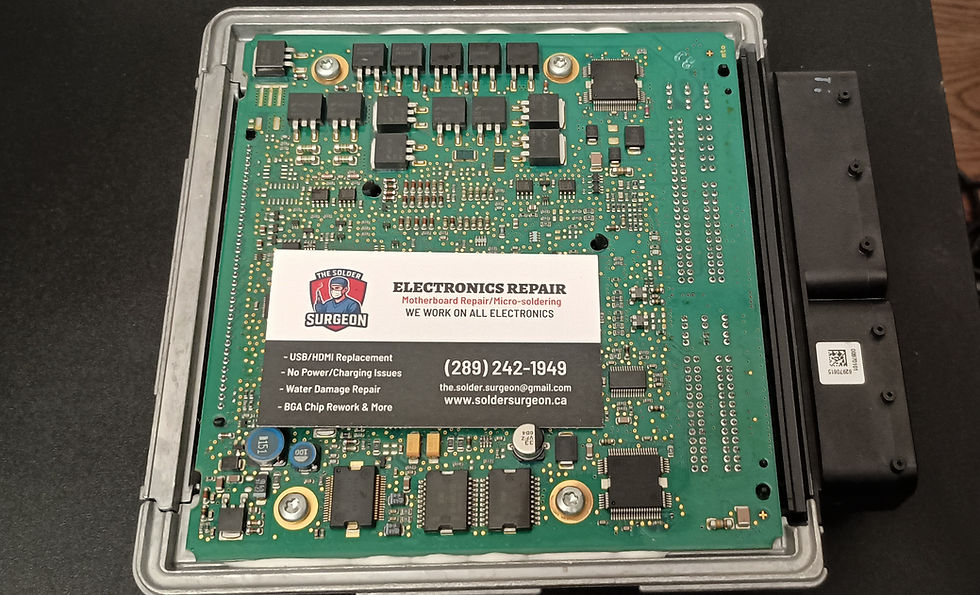
1. Common Failure Modes in Factory Engine Control Units
Automotive circuit boards are exposed to harsh environments that consumer electronics rarely face. Understanding how these boards degrade is the first step toward a permanent, component-level repair rather than an expensive module replacement.
Solder Joint Fatigue & Micro-Fractures: Constant heating and cooling cycles create expansion differential stress between lead-free solder joints and surface-mount device (SMD) pads. Over time, hair-line cracks form on high-current pins—such as injector driver transistors and voltage regulator legs—causing intermittent stalling, misfires, or loss of communication with scan tools.
Transient Voltage & Electrolytic Leakage: Aging capacitors within power supply sections eventually vent corrosive electrolyte directly onto the motherboard. This liquid degrades surrounding copper traces, creates high-resistance short circuits across surface-mount resistors, and destabilizes the internal 5V reference rail.
Conformal Coating Degradation: Automotive ECUs are sealed with silicone or epoxy conformal coating to protect against moisture. However, when moisture penetAutomotive ECU Repair and Performance Tuning Modificationsrates aging coating or when internal components overheat beneath it, hidden corrosion forms under IC chips and multi-layer through-hole barrels.
If your vehicle suffers from intermittent module shutdown, loss of driver signals, or corroded PCB traces, explore our comprehensive electronics repair capabilities to see how we restore compromised circuit boards.
2. High-Mass Thermal Management & Micro-Soldering Mechanics
Repairing or modifying an automotive ECU requires far more thermal energy than standard consumer circuit boards. Automotive PCBs utilize heavy, internal copper ground planes designed to sink heat away from high-power driver FETs.
Attempting to desolder components or clear through-hole barrels with a basic handheld soldering iron often leads to torn pads, lifted copper traces, and heat-stressed microprocessors.
Chemical Stripping and Thermal Prep
Before any hot-air station or iron touches the board, the protective conformal coating must be chemically neutralized using specialized solvents around the target work zone. Attempting to melt through conformal coating with heat burns toxic residue into the solder joints, preventing proper alloy wetting and creating brittle connections.
Once prepped, the board is placed on a digital bottom pre-heater. Bringing the entire board mass up to a uniform temperature (typically 150°C to 180°C) neutralizes the heatsinking effect of internal ground planes. This allows lead-free factory solder to reach liquidus state quickly and safely without applying excessive localized thermal shock to delicate surface-mount components.
For specialized board modifications, trace reconstruction, or high-mass board rework, visit our dedicated micro-soldering circuit board repair hub.
3. Performance Tuning Modifications: Hondata & Programmable Board Socketing
For performance applications—such as installing Hondata s300 daughterboards onto OBD1 Honda ECUs—precision soldering is paramount. Modern tuning modifications require installing dual-row 28-pin DIP sockets, latch ICs, and surface-mount resistor/capacitor bridging kits onto factory logic boards.
Through-Hole Clearance and Barrel Integrity
When prepping a factory ECU for socketing, all 28 through-hole pin locations must be completely cleared of lead-free solder. Using professional continuous-vacuum desoldering tools under high magnification ensures that the plated through-hole barrels remain 100% intact. If a through-hole barrel is damaged during desoldering, critical vertical interconnect access points (vias) between board layers are severed, resulting in a dead ECU that cannot communicate with tuning software.
Precision Latch and Resistor Installation
Surface-Mount Rework: Removing tiny 0805 or 0603 zero-ohm jumpers to enable external memory routing.
Socket Alignment: Micro-soldering high-grade, gold-plated machined-pin sockets to prevent pin corrosion and maintain low-resistance communication under heavy engine vibration.
Conformal Seal Application: Re-applying high-grade UV dielectric conformal coating over all new solder joints to prevent future humidity oxidation and environmental contamination.
4. Professional Bench Testing and Quality Assurance
Every automotive ECU that undergoes repair or performance modification at The Solder Surgeon is subject to rigorous post-service validation:
Diode Mode Signal Mapping: Checking all external header pins and driver lines for short circuits to ground or abnormal impedance values.
5V Reference & Power Distribution Check: Verifying stable internal power rail regulation before returning the unit to the chassis.
Microscopic Inspection: Verifying solder fillet geometry, joint wetting, and zero solder-bridging across high-density IC leads.
Whether you are restoring a vintage vehicle control module, repairing surge-damaged power planes, or installing precision performance tuning hardware, professional bench-level micro-soldering delivers factory-grade reliability.
Contact The Solder Surgeon today to discuss your automotive ECU repair or custom circuit board modification project!


Nice mobilefueldrain.co.uk